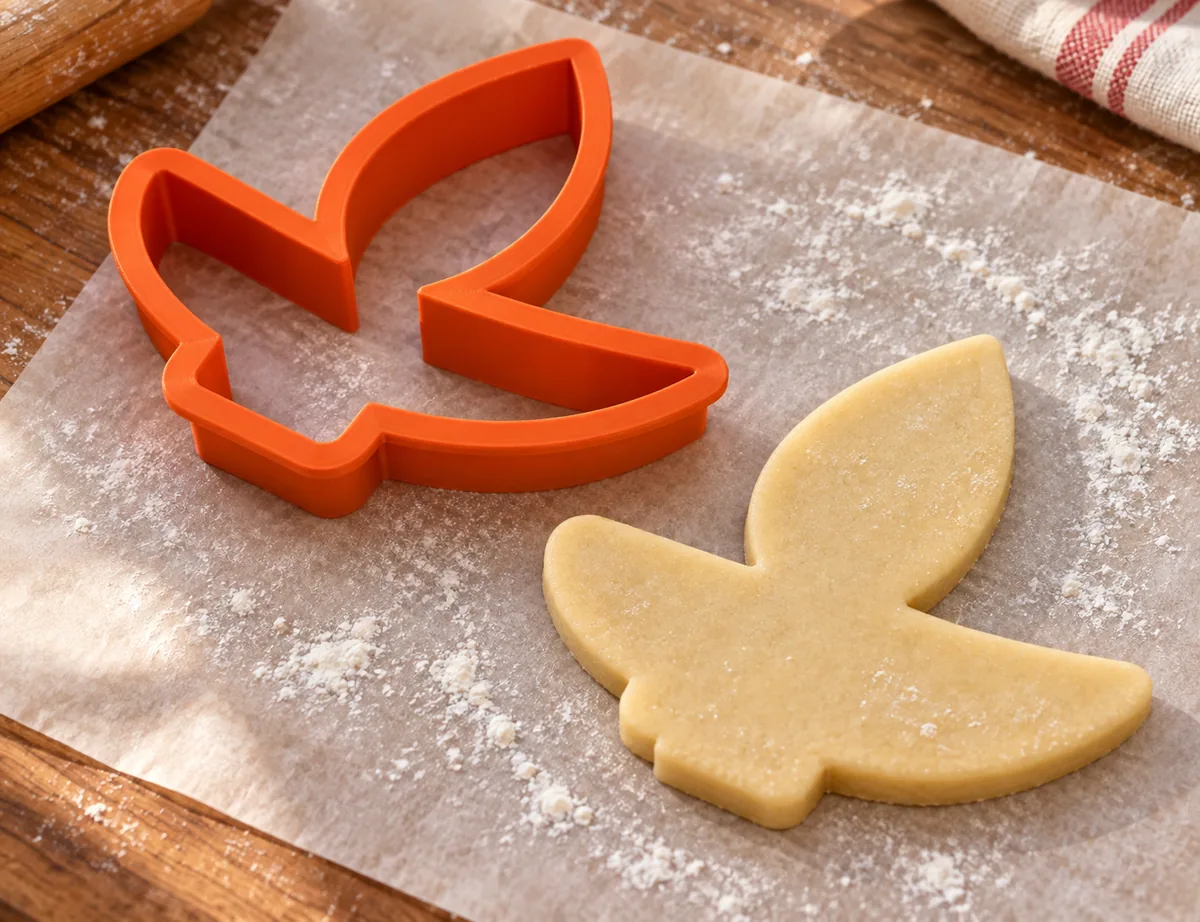










Ten Diwali shapes, ready to print
Every template above opens the cookie cutter generator with the shape already loaded. Pick a size, check the 3D preview and download a print-ready STL – the model is made on your own device in a few seconds. Diwali falls on 8 November 2026, so there is still time to print a full set and bake a test batch before the festival.
| Template | Opens at | Good for |
|---|---|---|
| Diya | 90 mm | Gift boxes, puja plates |
| Rangoli | 90 mm | Colourful icing, kids |
| Diwali Lantern (Kandil) | 95 mm | Lattice piping, tall trays |
| Lotus | 95 mm | Lakshmi puja, sweet boxes |
| Kalash | 90 mm | Puja sweets, box toppers |
| Rocket Cracker | 100 mm | Kids’ parties |
| Mango Leaf (Toran) | 85 mm | Edible toran, big batches |
| Peacock Feather | 95 mm | Wet-on-wet icing |
| Flower Pot Cracker (Anar) | 95 mm | Glitter and lustre |
| Star Lantern | 95 mm | Cake toppers, ombré icing |
Choosing the right size
The size you set is the cookie’s longest side. Most Diwali cookies look right at 80–100 mm: big enough to decorate, small enough to fit a sweet box. The round rangoli still cuts cleanly at 60 mm and the diya down to about 70 mm, which is handy for bite-sized cookies in a mithai assortment. Tall, slim shapes – the kandil and star lanterns with their tassels, the mango leaf with its stem, the peacock feather’s quill and the anar’s sparks – need more room: keep them at 85 mm or more, or the thin parts will snap when you lift the cookie. The generator goes from 30 to 200 mm, so you can also print a large 150 mm diya as a centrepiece cookie.
Print settings for PLA cookie cutters
Cookie cutters are quick, easy prints. The STL is already oriented with the grip rim on the bed and the blade pointing up, so it needs no supports. These settings work on any common printer:
| Setting | Value |
|---|---|
| Material | PLA (easiest) or PETG; food-contact grade if you can get it |
| Nozzle | 0.4 mm (use a 1.2–1.6 mm blade with a 0.6 mm nozzle) |
| Layer height | 0.2 mm |
| Walls / perimeters | 2–3 – the 1 mm blade prints solid |
| Infill | Any – the cutter is thin walls only |
| Supports | None |
| Print time | About 25–40 minutes per cutter |
To print the whole set at once, download each STL and arrange several on one build plate in your slicer. Leave a few millimetres between the grip rims so the nozzle does not drag across neighbouring parts.
Customising the blade and walls
Each template page has the full set of controls, so you can tune a cutter for your dough and printer:
- Blade height (6–30 mm, default 15 mm): the default comfortably cuts cookie dough rolled to 5–6 mm. Go taller for thick nankhatai or for cutting soft fudge and barfi.
- Blade thickness (0.6–2.5 mm, default 1.0 mm): thinner blades cut crisper edges; use 1.2 mm above 120 mm so large cutters do not flex.
- Grip rim width (0–10 mm, default 4 mm): the 2 mm-tall rim at the top makes the cutter comfortable to press and keeps it stiff. Widen it for small hands.
- Smoothing: rounds off very fine points. Raise it when you shrink a shape with thin parts.
The shape is mirrored inside the STL on purpose: you print the cutter rim-down and flip it over to use it, so the cookie comes out the right way round.
Planning ahead for December? The Christmas collection works the same way: see the 30 Christmas cookie cutters – tree, gingerbread man, Santa, snowflake, nutcracker and more.
Halloween comes just before Diwali this year: the 6 Halloween cookie cutters – pumpkin, jack-o’-lantern, ghost, bat, witch hat and black cat – use the same generator.
Tips for festive cookie cutters
- Print your cutters 2–3 weeks before the festival so you have time to test a batch.
- Chunky shapes are easiest for kids to decorate; shapes with thin parts (antlers, tassels, sparks) work best at 100 mm or larger.
- Every template prints as a single piece – separate parts are joined by thin bars on the top rim.
- Want your own design? Use the cookie cutter generator with any image or name.
Frequently asked questions
Are these Diwali cookie cutter STL files free?
Yes. All ten templates are free to open, resize and download as STL files for your own baking. There is no account and no watermark, and the model is built in your browser, so nothing is uploaded.
What size should I print a Diwali cookie cutter?
Most Diwali cookies are 80–100 mm on the longest side, and each template opens at a size that suits its shape (85–100 mm). The round rangoli still cuts well at 60 mm and the diya down to about 70 mm. Slim shapes with tassels, stems or sparks – kandil, star lantern, mango leaf, peacock feather, anar and rocket – are best kept at 85 mm or more.
What are the best print settings for a PLA cookie cutter?
Print in PLA or PETG with a 0.4 mm nozzle at 0.2 mm layer height, 2–3 walls and no supports. The STL is already oriented grip-rim-down. A typical 90 mm cutter takes about 25–40 minutes.
Are 3D printed cookie cutters food safe?
They are fine for the short contact of cutting chilled dough if you look after them. Layer lines can trap dough, so use a food-contact filament if you can, wash by hand in warm (not hot) soapy water, dry straight away, and keep PLA out of the dishwasher because heat softens it. Replace a cutter once it is scratched or stained.
Can I change the blade height or wall thickness?
Yes. Every template page has the full generator: blade height 6–30 mm (15 mm default), blade thickness 0.6–2.5 mm (1.0 mm default), grip rim width 0–10 mm (4 mm default) and smoothing. Use a 1.2 mm blade for cutters above 120 mm, and 1.2–1.6 mm if you print with a 0.6 mm nozzle.
Which dough works best with these cutters?
Doughs that hold their shape: shortbread, sugar cookies, atta or whole-wheat biscuits and firm nankhatai dough. Roll to 5–6 mm and chill the cut cookies for 10–15 minutes before baking. Nankhatai spreads more, so choose bold shapes such as the rangoli or diya for it.
When is Diwali 2026, and when should I print?
Diwali falls on 8 November 2026. Print your cutters two to three weeks before so you have time for a test batch – each one takes under an hour, so you can print the whole set in an afternoon.
More collections: Halloween cookie cutters · Christmas cookie cutters